

Pass Your Welder Red Seal Exam
Practice with welder-specific questions, track your performance by block, and study with detailed explanations designed to help you pass with confidence.
Free trial · Cancel anytime
Turn Your Practice Into a Study Plan
Inside the platform, the same tracking runs across thousands of welder questions so every study session focuses on what actually moves your score.
Accuracy by Block
Drill into how you score on every major work-activity block.
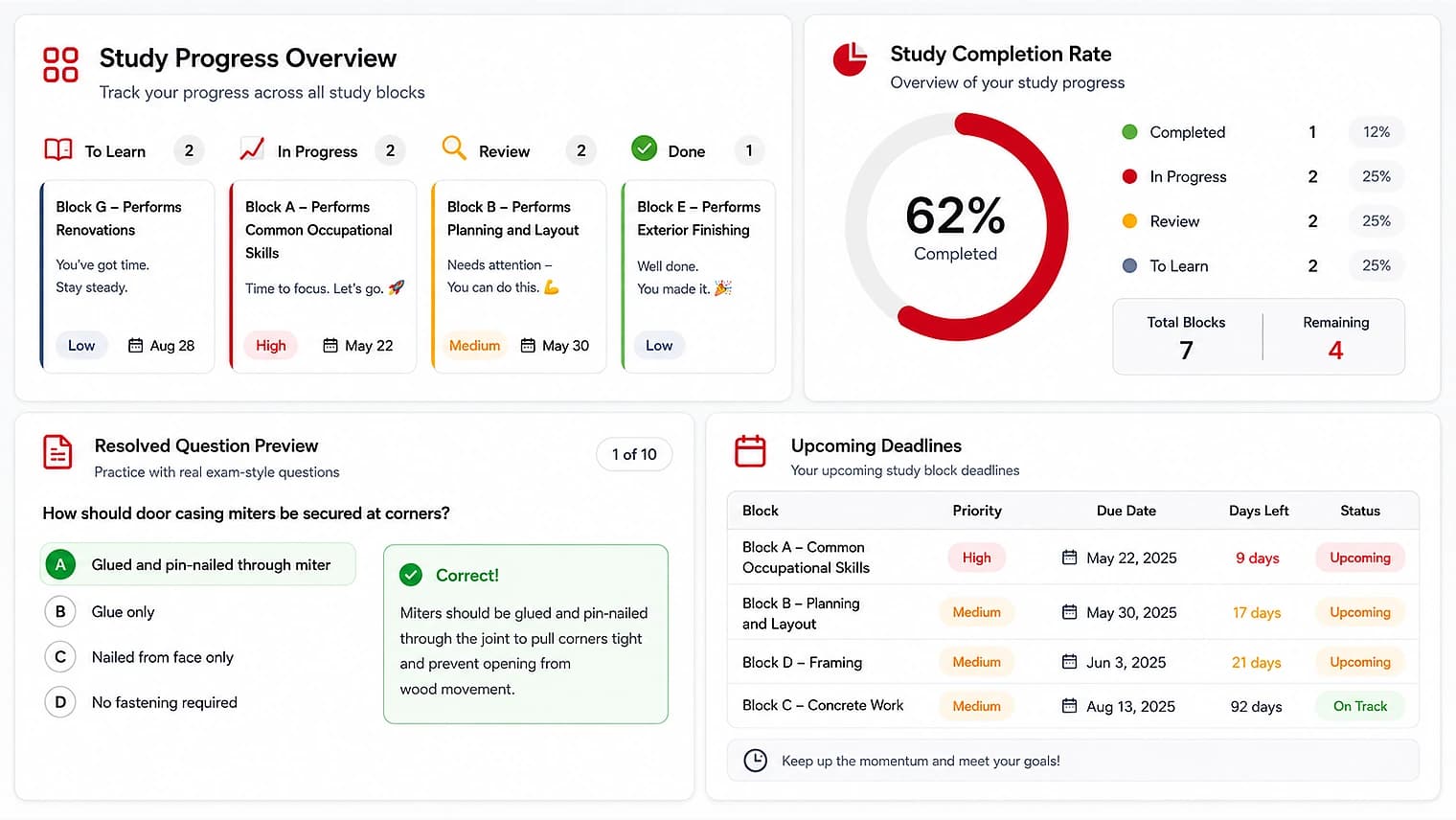
Study Progress
Track completion across blocks, tasks, and topics in one view.
Strengths & Weaknesses
Spot the topics that need attention before they cost you points.
Recommended Topics
Get smart suggestions on what to study next based on your results.
Exam Readiness
See a real-time signal of how ready you are for test day.
See the Platform in Action
Track your accuracy by block, see study progress at a glance, and focus on the topics that move the needle for exam day.
Everything You Need to Prepare with Confidence
Practice with trade-specific questions, understand every answer, and focus your study time where it matters most.
Comprehensive Question Bank
Thousands of exam-style questions built for your specific Red Seal trade.
Smart Progress Tracking
Strengths and weaknesses by block and task, so you always know what to study next.
Timed Exam Simulations
Practice under real Red Seal timing to build confidence for exam day.
Detailed Explanations
Every answer explained with clear rationales grounded in trade theory and code.
Trade-Specific Content
Content tailored per trade — Plumber, Electrician, Carpenter, Welder and more.
Updated Practice Questions
Questions kept aligned with current Red Seal standards and expectations.
Prepare smarter.
Choose the plan that fits you.
Transparent pricing that fits your timeline.
No lock-ins. Cancel anytime.
Billed monthly · renews until you cancel
- Full question bank for your trade
- Detailed explanation on every question
- Filter by block and task
- Analytics dashboard with progress tracking
Billed every 6 months · renews until you cancel
- Everything in Essential
- Works out to $14.50/mo — 46% off the monthly plan
- One charge every 6 months instead of six
Billed yearly · renews until you cancel
- Everything in Plus
- Full Exam Simulation (4-hour, official blueprint)
- Per-block performance and recommendations
- Exam readiness signal across all blocks
- Works out to $10.60/mo — the lowest rate we offer
Not sure yet? Try it free first.
7 days · 20 real exam-style questions from your trade · live analytics. No credit card required.
Frequently Asked Questions
Available Now · Start Your Study Today
Join tradespeople across Canada using Pass Red Seal to practice smarter, track progress, and build exam confidence.
Cancel anytime · 7-day money-back guarantee